
Brushed Brass vs Matte Black Cabinet Hardware: Which Shows Water Spots?
Choosing between brushed brass vs matte black cabinet hardware often feels like a balancing act between aesthetic warmth and modern, high-contrast design. Many homeowners find themselves stuck at the intersection of style and maintenance when renovating their kitchens or bathrooms. If you are specifically concerned about water spots, the short answer is that matte black…

Choosing between brushed brass vs matte black cabinet hardware often feels like a balancing act between aesthetic warmth and modern, high-contrast design. Many homeowners find themselves stuck at the intersection of style and maintenance when renovating their kitchens or bathrooms. If you are specifically concerned about water spots, the short answer is that matte black hardware tends to show white mineral deposits and water stains more visibly than brushed brass.
The contrast between the dark, opaque finish of black hardware and the light-colored minerals in water makes every splash highly noticeable. Understanding how these finishes interact with your daily routine will help you make a choice you won’t regret in a year.
The Direct Answer: Comparing Water Spot Visibility

When you compare the two finishes side-by-side, matte black is the clear loser in the battle against water spots. Because the surface is a solid, dark, non-reflective color, any drying droplet leaves behind a white, chalky residue. This is particularly problematic in areas with hard water, where mineral content is high.
In contrast, the texture and multi-tonal nature of brushed brass hide imperfections much more effectively. The subtle, metallic graining of brass helps break up the light, making those small, dried water spots nearly invisible to the casual observer.
If you have a busy household with children or frequent guests, this difference in maintenance becomes a practical reality rather than just a design preference. Matte black requires frequent wiping to look pristine, whereas brushed brass can go much longer between cleanings.
If you are aiming for a low-maintenance home environment, the visual forgiveness of brass is a significant asset. However, if you are committed to the modern, industrial look, you may simply decide that the extra cleaning time is a trade-off you are willing to make for the style you prefer.
Why Matte Black Finishes Struggle with Residue
The chemistry of a matte black finish is the primary reason it highlights water spots so aggressively. Most matte black hardware is created using a powder coating or a specialized plating process that results in a non-reflective, porous-looking surface. While these surfaces are generally durable, they are not hydrophobic.
Water sits on the surface until it evaporates, leaving behind whatever was dissolved in it. Because the background color is so dark, the light-colored calcium and magnesium deposits stand out sharply against the finish.
You will find that this issue is compounded in bathrooms where steam and frequent splashes are common. When water droplets condense on a black faucet or cabinet knob, they collect dust and minerals, creating a visible ring once they dry. This phenomenon is often referred to as “ghosting” or “spotting.”
It isn’t that the finish is damaged, but rather that the laws of optics work against the dark color. If you have a water softener installed in your home, you might notice fewer spots, but they will still be more apparent on black than on a metallic finish.
The Forgiving Nature of Brushed Brass

Brushed brass offers a much more forgiving surface due to its inherent metallic luster and physical texture. The “brushed” aspect of the finish involves tiny, linear scratches intentionally applied to the metal to create a satin sheen. These lines serve to diffuse light, which acts as a camouflage for minor surface imperfections.
When a water droplet dries on brass, the mineral ring is less likely to be sharply defined. Instead, it blends into the complex, reflective surface of the metal.
This finish is often categorized as a “living” or “warm” metal, which adds a sense of depth to cabinetry. Beyond just hiding water spots, it tends to mask fingerprints and oils much better than a flat, matte surface.
In high-traffic zones like the kitchen, this makes brass a functional choice that doesn’t sacrifice elegance for utility. You will find that even when it does get dirty, a quick swipe with a soft cloth restores the shine without needing a specialized cleaner.
Understanding Hard Water Impact
The composition of your local water supply is perhaps the most important variable in this equation. Hard water is defined by its high concentration of minerals, specifically calcium and magnesium, which are the primary culprits behind stubborn white spots.
If you live in a region where the water is classified as “hard,” your choice of hardware will be significantly affected. In these areas, matte black hardware will almost certainly require daily maintenance to avoid looking dull or unkempt.
You can often check your local utility website to see the hardness levels of your municipal water. If your area falls into the “very hard” category, you might want to reconsider your preference for dark, solid-colored fixtures.
While you could technically use a sealant or wax on the hardware to repel water, this adds an extra chore to your maintenance schedule. Brushed brass, by comparison, remains resilient even when exposed to harder water sources, making it a more stress-free option for many regions.
Comparing Maintenance and Cleaning Requirements
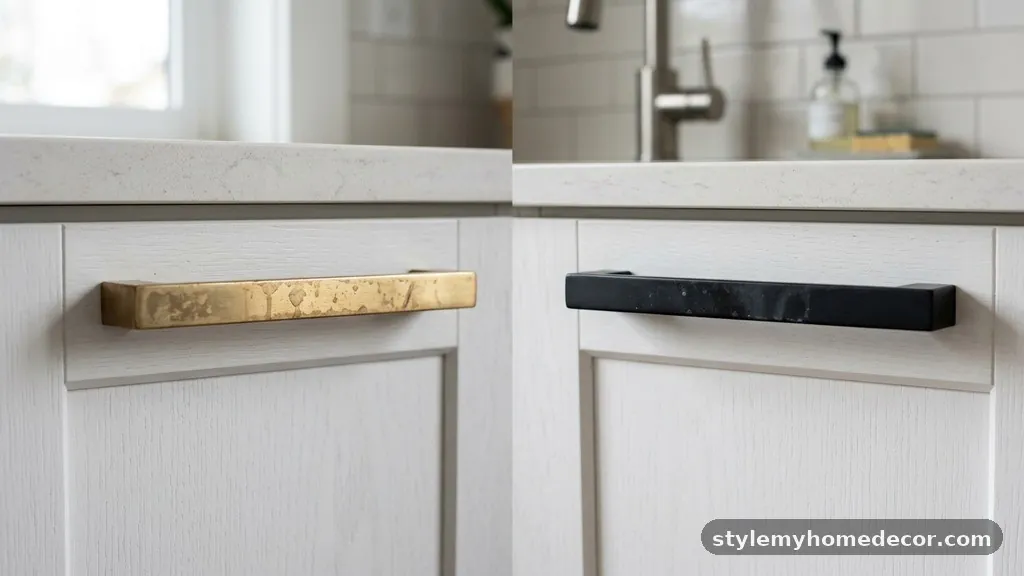
When maintenance becomes a chore, the satisfaction of a design choice often wanes. To keep matte black hardware looking brand new, you generally need to wipe it down with a damp, lint-free cloth after every use.
You must also avoid harsh, abrasive cleaners that can strip the finish or create permanent dull spots. Acidic cleaners like vinegar are often recommended for other surfaces, but they can be risky for certain plated black finishes, so you must always check the manufacturer’s care instructions.
For brushed brass, the maintenance is significantly more relaxed. Because the finish isn’t a simple, opaque coating, it doesn’t show the same “tide marks” that black does.
You can clean it with mild soap and water, and it generally requires less frequent attention. The following table illustrates the general maintenance differences between the two, assuming a standard residential environment.
| Feature | Matte Black | Brushed Brass |
|---|---|---|
| Water Spot Visibility | High | Low |
| Fingerprint Masking | Low | Moderate |
| Cleaning Frequency | High (Daily/Weekly) | Low (Monthly) |
| Light Reflection | None (Absorbent) | High (Diffuse) |
Design Versatility and Aesthetic Longevity
Beyond the issue of water spots, you should consider how each finish fits into the broader design of your home. Matte black is synonymous with modern, industrial, and minimalist design styles. It provides a sharp, graphic element to a room, especially against white or light-gray cabinetry.
It acts as a frame, drawing the eye to the architectural lines of your furniture. However, some designers argue that the “black hardware craze” might eventually feel dated, much like the oil-rubbed bronze trend of the early 2000s.
Brushed brass, on the other hand, is a classic that has seen a massive resurgence in recent years. It brings a sense of warmth and luxury to a space, working exceptionally well with both traditional and contemporary interiors. It pairs beautifully with navy blue, forest green, white, and charcoal cabinets.
Because it has a more timeless, “jewelry-like” quality, many homeowners find that they tire of it less quickly than the stark contrast of black. It feels more intentional and less like a passing trend.
The Role of Fixture Quality

Not all finishes are created equal, and the quality of the manufacturing process can influence how susceptible your hardware is to water spots. High-end manufacturers often use physical vapor deposition (PVD) to apply their finishes, which is significantly more durable and resistant to corrosion than basic powder coating.
PVD finishes on matte black hardware are much less likely to show water spots because the surface is smoother and more chemically inert. If you are set on black, investing in a high-quality, PVD-coated product is worth the extra cost.
Similarly, the quality of brushed brass varies between manufacturers. Cheaper brass-plated items may tarnish or lose their luster over time, whereas solid brass or high-quality PVD-brass will maintain its color and texture for decades. When shopping, always look for details regarding the finish technology.
If a product is labeled as “durable PVD finish,” it will likely perform better in terms of maintenance than a generic, budget-friendly alternative. You can find more information on hardware material standards via the American National Standards Institute guidelines for residential fixtures.
Strategies for Minimizing Water Spots
If you choose a finish that is prone to spotting but love the look too much to switch, there are ways to manage the issue. The most effective method is simply to keep a microfiber cloth nearby to wipe down your hardware after you finish using a sink or shower.
This prevents the water from sitting long enough to evaporate and leave a mineral deposit behind. It takes only a few seconds but makes a massive difference in the long-term appearance of your fixtures.
Another strategy is to apply a very thin layer of high-quality car wax or a specialized metal protectant to the hardware. This creates a hydrophobic barrier that encourages water to bead up and roll off rather than spreading and drying into a spot.
You should test this on a small, inconspicuous area first to ensure it doesn’t change the look of the finish. For matte black, ensure you use a wax that is specifically designed for non-glossy surfaces to avoid creating unwanted shine.
Common Hardware Configurations
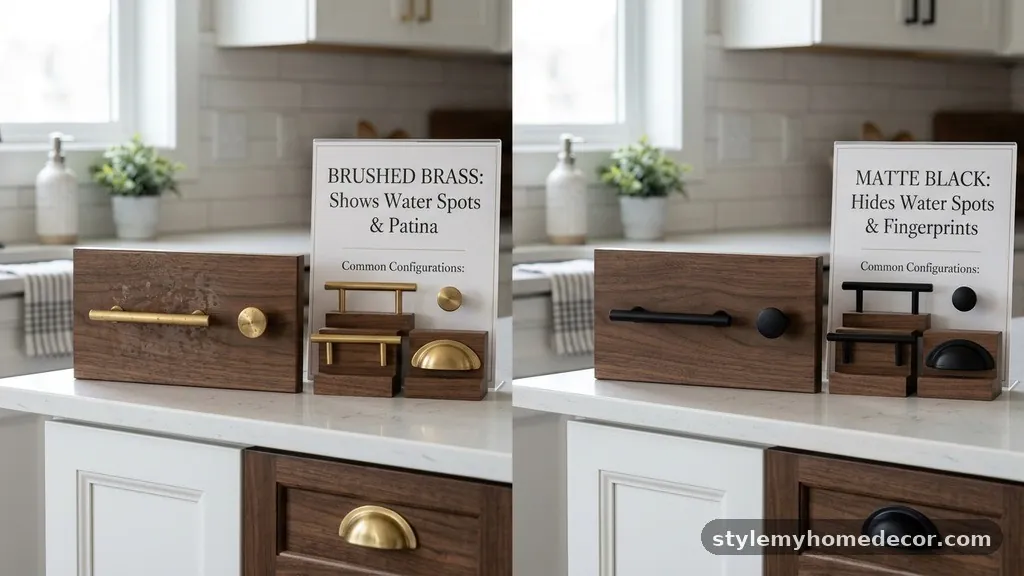
When planning your layout, consider the placement of your hardware relative to water sources. In a bathroom, the faucet handle is clearly the most vulnerable spot.
However, if you are installing cabinet hardware on a vanity, the proximity to the sink matters. Knobs or pulls located directly next to a basin will be splashed significantly more often than those on a medicine cabinet or linen closet.
* High-Splash Zones: Faucets, sink-adjacent drawer pulls, and shower handles.
* Low-Splash Zones: Upper cabinet knobs, pantry pulls, and closet hardware.
* Maintenance-Heavy Areas: Any fixture within 12 inches of a high-flow water outlet.
If you are worried about the maintenance of matte black, you could opt for a “mixed metal” approach. Use brushed brass for the cabinet hardware, which is less prone to spotting, and reserve the matte black for less frequently touched items like light fixtures or towel racks. This allows you to incorporate both styles without creating a maintenance nightmare in your kitchen or bath.
FAQ: Common Questions on Hardware Finishes
Does matte black hardware eventually peel?
Low-quality matte black hardware can indeed peel or chip over time, especially if it is a simple painted finish. This usually happens around the edges where the hardware is gripped most frequently. Choosing a high-quality, PVD-coated finish significantly reduces the risk of peeling, as the finish is bonded to the metal at a molecular level.
Is brushed brass considered a trend that will fade?
While it has been popular recently, brass is a traditional metal finish that has been used in interior design for centuries. Unlike trendy, neon, or highly specific color-based finishes, brushed brass has a timeless quality that adapts to various design styles. It is unlikely to become as “outdated” as some of the more extreme color trends.
Can I mix black and brass hardware in the same room?
Mixing metals is a highly effective way to add depth to a room’s design. You can easily pair matte black lighting fixtures with brushed brass cabinet hardware, or vice versa. The key is to ensure the other elements in the room, such as the faucet or appliances, help tie the two finishes together so the transition feels intentional.
What is the best way to clean water spots off matte black?
The best approach is to use a soft, damp microfiber cloth and a mild soap solution. Avoid using abrasive sponges or scrub brushes, as these will permanently scratch the matte finish. If water spots persist, a very mild solution of water and white vinegar may work, but always rinse thoroughly and dry immediately to prevent new spots from forming.
Is brushed nickel a better alternative to both?
Brushed nickel sits somewhere in the middle of the spectrum. It is more forgiving than matte black regarding water spots and fingerprints, but it lacks the warmth and depth of brushed brass. If your primary concern is maintenance, brushed nickel or a similar stainless-steel finish is often the most practical choice for high-moisture environments.
Final Considerations for Your Home
Deciding between brushed brass vs matte black cabinet hardware ultimately comes down to your personal tolerance for maintenance versus your aesthetic vision. If you prioritize a low-effort cleaning routine, the forgiving nature of brushed brass makes it the superior choice.
It hides water spots, masks fingerprints, and adds a warm, inviting glow to your kitchen or bathroom. If you are drawn to the crisp, modern impact of matte black, you must be prepared to wipe down your hardware regularly to keep it looking sharp.
Remember that the quality of the finish you purchase will impact how much maintenance you actually have to perform. Investing in high-quality PVD-coated hardware can bridge the gap, making even a matte black finish more resistant to the elements. Regardless of the finish you select, consider the specific needs of your household and the typical water conditions in your home.
By choosing wisely now, you ensure that your hardware remains a beautiful, functional detail for years to come. We invite you to look at your daily habits and select the finish that fits your lifestyle as well as your design goals.