Best Hinge Opening Angle for Corner Cabinets (105° vs 165° vs 170°)
Choosing the best Hinge Opening Angle for Corner Cabinets (105° vs 165° vs 170°) is a common challenge for homeowners and cabinet installers alike. Selecting the right hardware determines how easily you can access your kitchen corner storage and whether your doors will hit adjacent drawers or appliances. While 105-degree hinges are the industry standard…
Choosing the best Hinge Opening Angle for Corner Cabinets (105° vs 165° vs 170°) is a common challenge for homeowners and cabinet installers alike. Selecting the right hardware determines how easily you can access your kitchen corner storage and whether your doors will hit adjacent drawers or appliances. While 105-degree hinges are the industry standard for most cabinets, they often fail in corner configurations where wider access is required.
Understanding the physical difference between a 105°, 165°, and 170° hinge is essential for ensuring your kitchen remains functional. This article breaks down the specific performance of each hinge type to help you make the right choice for your home.
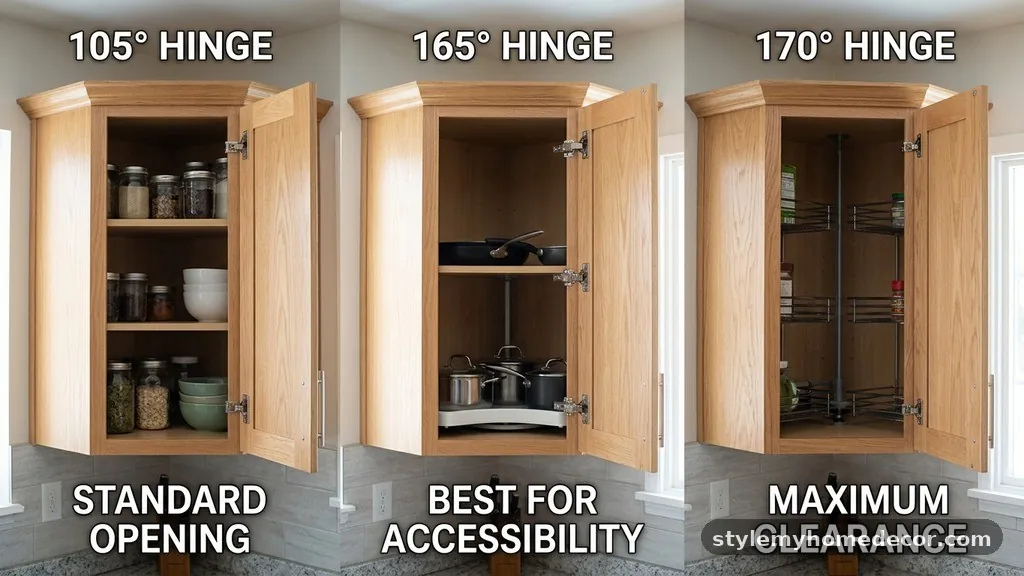
The 165-degree or 170-degree hinge is the best choice for corner cabinets that require wide clearance. Specifically, if you are using pull-out organizers or internal drawers, these wider angles are essential. A standard 105-degree hinge will restrict the door to a point where it partially blocks the opening, making it difficult to slide out trays or reach items deep in the corner.
If your goal is full access to the cabinet interior, you should skip the 105-degree option and look toward the 165-degree or 170-degree hardware. These hinges allow the door to fold back almost completely flat against the cabinet side, providing an unobstructed path for your storage solutions.
Understanding Hinge Opening Angles
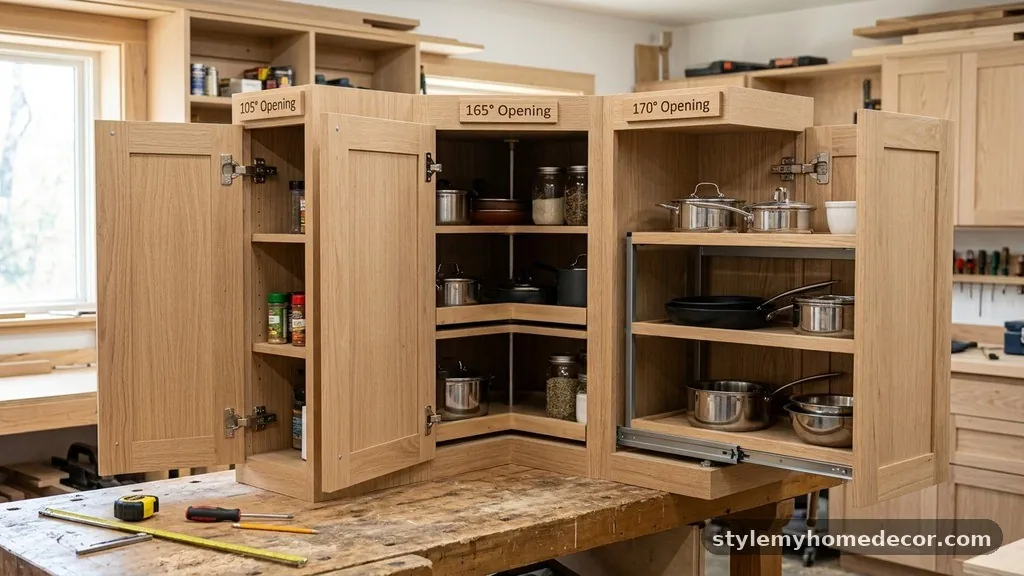
A hinge opening angle defines the maximum distance a door can swing away from the cabinet frame. The standard hinge found on most residential kitchen cabinets is a 105-degree model.
This angle is perfectly adequate for pantry doors or standard base cabinets where a full 90-degree opening is more than enough to clear the frame. However, corners introduce a unique geometric problem.
When two cabinets meet at a 90-degree corner, the doors often sit very close to each other. If you use a 105-degree hinge, the door will not swing far enough to prevent it from encroaching on the interior space.
This creates a bottleneck that makes it nearly impossible to remove large pots or install pull-out wire baskets. The 165-degree and 170-degree hinges solve this by allowing the door to swing well beyond the standard range.
Why 105-Degree Hinges Often Fail in Corners
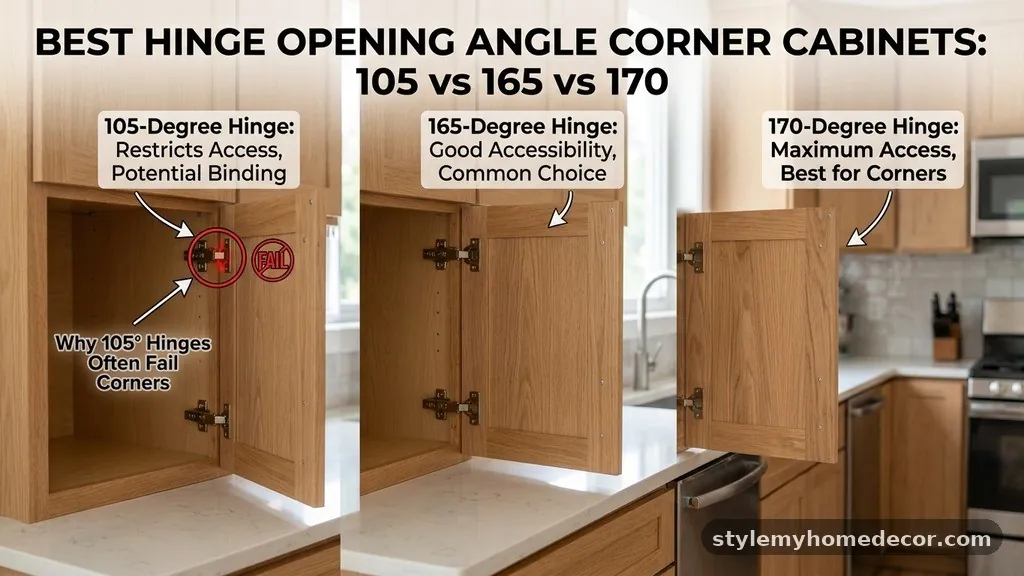
The 105-degree hinge is the most common hardware found in hardware stores because it is inexpensive and durable. It is built for a standard, flat cabinet run where the door needs to move just enough to allow access.
In a corner, however, the door needs to clear the adjacent door handle or the perpendicular cabinet face. If the door only opens to 105 degrees, you are fighting against the edge of the door every time you try to reach inside.
This limitation is particularly frustrating if you have internal slide-out shelves. A shelf that is 18 inches wide will likely hit the edge of the door if the hinge doesn’t allow the door to move completely out of the way.
You might be able to open the door, but you will find yourself scraping your knuckles against the door edge as you pull the shelf forward. For most corner applications, this hinge is simply too restrictive for daily use.
The Mechanics of 165-Degree and 170-Degree Hinges
These wide-angle hinges are designed with an extra pivot point that allows the door to move further away from the cabinet box. A 165-degree hinge, like those produced by manufacturers such as Blum, is engineered specifically for corner applications where maximum clearance is the priority.
The extra 60 to 65 degrees of movement makes a massive difference in how the cabinet functions. When the door is fully open, it sits nearly parallel to the cabinet side.
The difference between 165 and 170 degrees is marginal in practice, though it can matter in tight custom cabinet work. A 170-degree hinge provides that tiny bit of extra breathing room that might prevent a door from bumping into a refrigerator handle or a nearby wall.
If you have the space to mount them, both options perform significantly better than the 105-degree alternative. They transform a “blind” corner cabinet from an inaccessible hole into a highly functional storage area.
Comparing Hinge Specifications
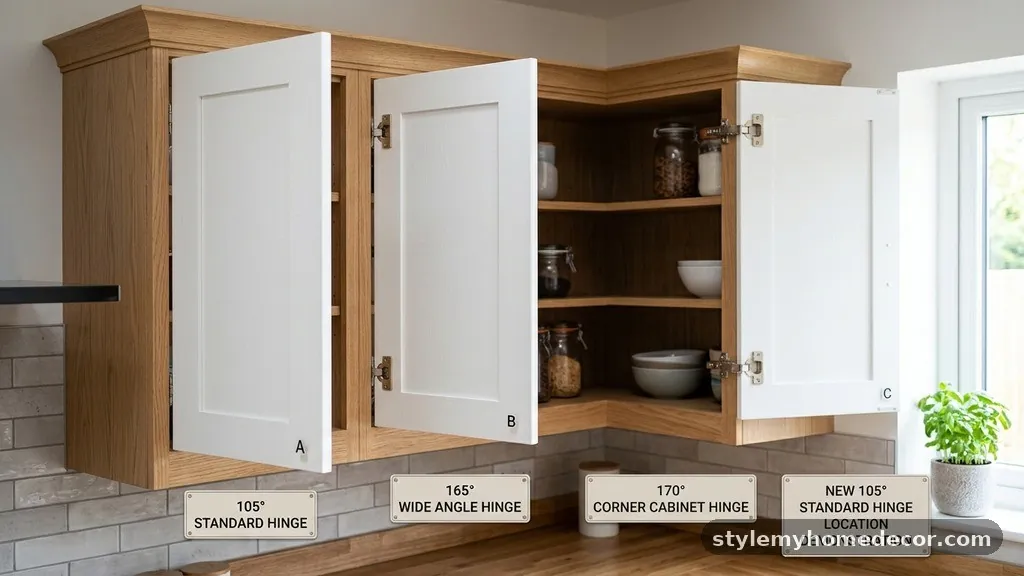
To visualize why the best Hinge Opening Angle for Corner Cabinets (105° vs 165° vs 170°) matters, it helps to compare their movement capabilities side-by-side. The following table highlights the functional differences you will experience when installing these in a corner configuration.
| Hinge Angle | Best Use Case | Access Level |
|---|---|---|
| 105° | Standard flat-run cabinets | Limited (Standard) |
| 165° | Corner cabinets with pull-outs | High (Excellent) |
| 170° | Tight corners near obstacles | Maximum (Clearance) |
Installation Challenges with Wide-Angle Hinges
Replacing a 105-degree hinge with a 165-degree or 170-degree hinge is not always a simple drop-in swap. These wider hinges often have a larger mounting cup that requires a specific diameter hole drilled into the door.
If your existing doors were drilled for a standard 35mm cup, you might find that the wider hinge requires a different bore depth or hole position. You should always check the manufacturer’s technical data sheet before purchasing.
Additionally, these hinges require more clearance on the cabinet side to allow the hinge arm to swing properly. If your cabinet is built with a thick face frame, the hinge might bind against the wood before it reaches its full potential.
Most modern frameless cabinets handle these hinges perfectly, but older, framed cabinets might require a mounting plate spacer. Always measure your door thickness and the overlay distance to ensure the hinge doesn’t conflict with the cabinet structure.
Selecting the Right Brand for Your Cabinets
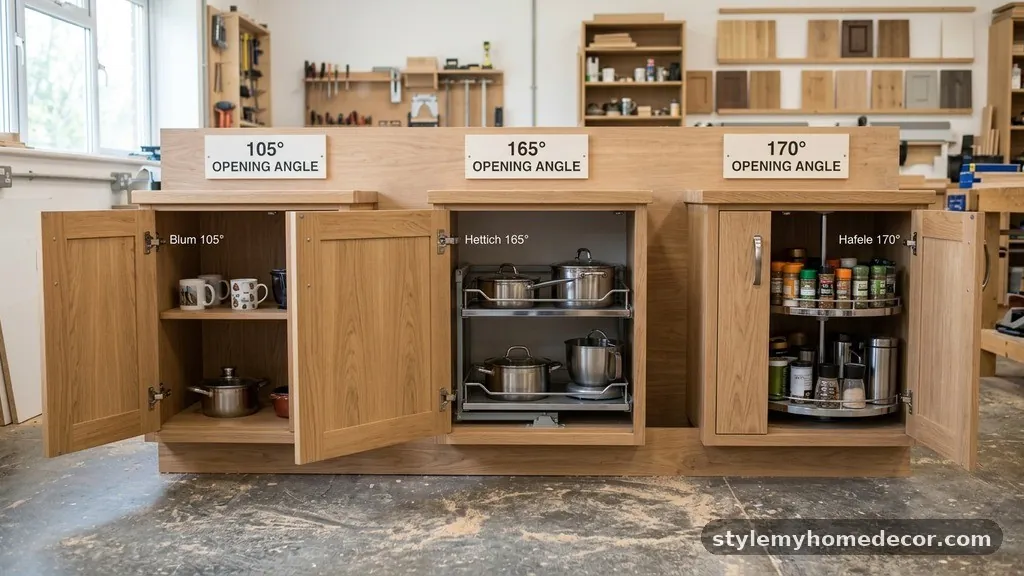
When you decide to upgrade, stick to reputable brands to ensure longevity. Cheap, unbranded hardware often fails under the weight of a heavy kitchen cabinet door, especially when the hinge is extended to its maximum angle.
A high-quality hinge will feature a soft-close mechanism that prevents the door from slamming when you push it shut. This is vital for wide-angle hinges, as the extra mass and leverage mean they can close with more force than a standard hinge.
Look for features like three-dimensional adjustment screws. These allow you to fine-tune the door position up, down, left, and right, which is critical in corner cabinets where gaps are highly visible.
A well-adjusted door will sit perfectly flush with the adjacent cabinet, even when it is a high-swing 170-degree model. Investing in quality hardware now will save you from having to replace sagging or misaligned doors in just a few years.
Managing Door Overlay and Clearance
Overlay refers to how much of the cabinet frame the door covers when closed. Wide-angle hinges behave differently depending on whether you have a full overlay or an inset door.
If you have a full overlay door, the hinge needs to move the door completely away from the cabinet edge to prevent contact. If you have an inset door, the hinge must be designed to pivot without hitting the frame it is recessed into.
Always consult the hinge manufacturer’s overlay charts. These charts tell you exactly how much space you need between the door and the cabinet edge to prevent binding.
If you get this wrong, the door will hit the cabinet frame before it reaches the full 165-degree or 170-degree opening. Taking the time to calculate these clearances is the difference between a professional-looking kitchen and one that feels clunky.
Common Mistakes During Replacement
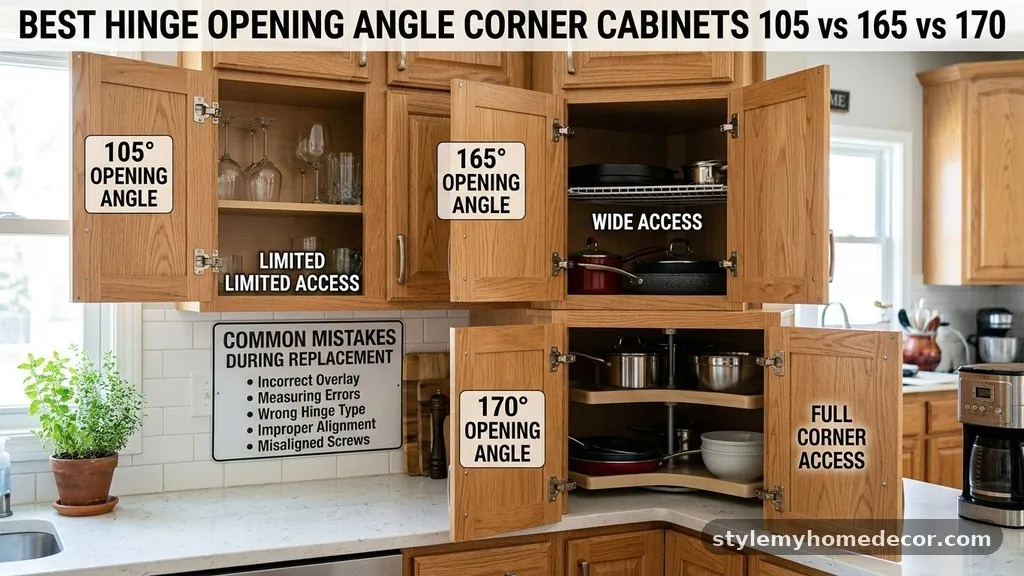
One of the most frequent mistakes people make is assuming all hinge cups are the same size. While the 35mm diameter is standard, the distance from the edge of the door to the center of the hole—known as the drilling distance—can vary.
If you buy a new hinge and the holes don’t align, you will have to plug and re-drill the wood. This weakens the door and is difficult to fix without professional tools.
Another common error is failing to account for the weight of the door. Wide-angle hinges are long and put more stress on the mounting screws.
If your doors are tall or made of heavy solid wood, you may need to add a third hinge to the center. This prevents the door from sagging over time, which would otherwise ruin the alignment of your corner cabinet doors.
Considering Soft-Close Technology
Modern kitchen hardware has evolved to include integrated soft-close dampers. When choosing your 165-degree or 170-degree hinges, ensure they are equipped with this feature.
Because these doors have a wider swing, they can build up significant momentum if they are pushed closed quickly. A soft-close mechanism catches the door and brings it to a gentle stop.
This also prevents the hinge from “bouncing” when it meets the cabinet frame. Without a damper, the wide-angle hinge can cause the door to vibrate or click against the cabinet, which sounds cheap and wears out the finish on your doors.
Most major brands now offer this as a standard feature on their premium hinge lines. It is well worth the small extra cost for the added comfort and protection for your cabinetry.
FAQ: Common Questions About Hinge Angles
Do 170-degree hinges fit all cabinet types?
No, they are primarily designed for frameless, full-overlay cabinets. If you have a traditional face-frame cabinet, you may need a special adapter plate or a specific hinge version that accounts for the frame thickness. Always check the compatibility with your specific cabinet construction before buying.
Can I install a wide-angle hinge myself?
Yes, if you have basic tools like a drill, a screwdriver, and a measuring tape. If the mounting holes match your existing doors, it is a straightforward swap. If the holes do not match, you will need a 35mm Forstner bit to drill new cups, which requires more precision and confidence.
Why does my door hit the adjacent cabinet even with a wide-angle hinge?
This usually happens because the hinge is not adjusted correctly or the door overlay is too deep. Check the adjustment screws on the hinge arm to see if you can shift the door away from the adjacent cabinet. If that doesn’t work, you may need a different type of mounting plate to increase the clearance.
Is there a difference in strength between 105 and 170-degree hinges?
Generally, no, as long as you buy from reputable manufacturers. However, because the 170-degree hinge has a longer arm, it can experience more leverage stress. This is why it is important to ensure all screws are tightened properly and to add a third hinge if the door is particularly heavy or tall.
Should I replace all hinges in the kitchen or just the corner ones?
You should only replace the hinges that are causing access issues. There is no functional reason to upgrade standard flat-run cabinets to 170-degree hinges, as they are more expensive and offer no benefit in those locations. Stick to the 105-degree hinges for the rest of the kitchen to keep costs down and maintain a consistent look.
Final Thoughts on Hinge Selection
Finding the best Hinge Opening Angle for Corner Cabinets (105° vs 165° vs 170°) comes down to how much access you need to the space behind the door. If you have pull-out drawers or just want to avoid the annoyance of the door blocking your way, the 165-degree or 170-degree options are the clear winners. They provide the clearance necessary to make a cramped corner cabinet truly useful.
While they might require a bit more attention during installation, the long-term benefit of a fully accessible cabinet is worth the effort. By choosing the right angle and ensuring proper adjustment, you will dramatically improve the functionality of your kitchen. If you have further questions about your specific cabinet layout, check with a local hardware specialist to confirm your measurements.