
Full Overlay vs Half Overlay vs Inset Cabinets: Hardware Differences
Choosing the right door style is a foundational step in any kitchen renovation, as the debate surrounding full overlay vs half overlay vs inset cabinets significantly dictates the final look and functionality of your space. While the visual aesthetic is often the primary driver for homeowners, the underlying hardware requirements and installation precision vary drastically…
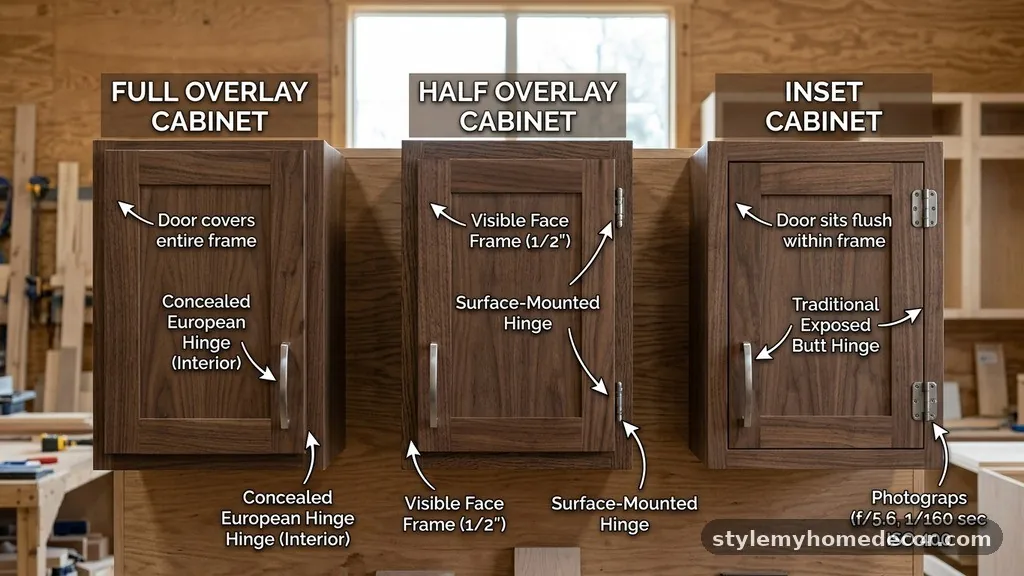
Choosing the right door style is a foundational step in any kitchen renovation, as the debate surrounding full overlay vs half overlay vs inset cabinets significantly dictates the final look and functionality of your space. While the visual aesthetic is often the primary driver for homeowners, the underlying hardware requirements and installation precision vary drastically between these three options.
Understanding these technical nuances early ensures that your cabinetry not only reflects your desired style but also performs reliably over years of daily use. This analysis breaks down the mechanical differences and hardware demands of each configuration to help you make an informed decision for your home.
The primary difference lies in how the cabinet door interacts with the cabinet face frame or the box itself. With inset cabinetry, the door sits flush inside the frame, requiring extremely tight tolerances and specific hinges. Full overlay cabinets cover almost the entire frame, creating a sleek, modern look that hides the wood box behind the doors.
Half overlay, often called partial overlay, leaves a portion of the frame exposed around the door, providing a more traditional aesthetic. The hardware you select must correspond exactly to these mounting positions to ensure that doors open without rubbing against adjacent panels or frames.
Defining the Structural Differences
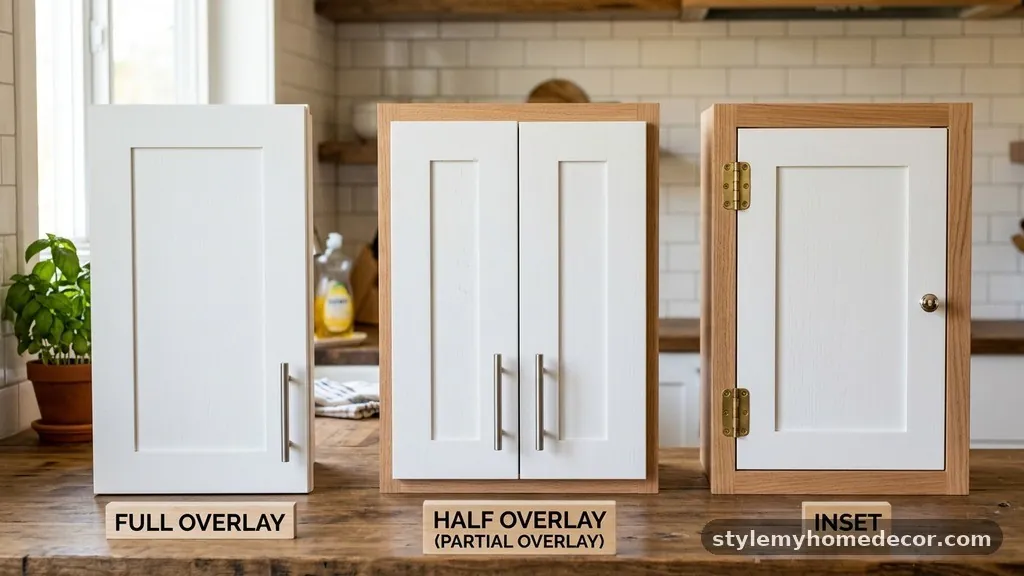
Inset cabinets represent the gold standard of traditional craftsmanship. Because the door is set into the frame, the gap between the door and the opening must be consistent on all four sides.
This requires a level of manufacturing precision that is significantly higher than other styles. If the humidity in your home changes, solid wood doors might expand, causing them to bind against the frame.
Full overlay doors are designed to sit on top of the cabinet box, covering nearly all of the frame. This style is often used in frameless, or European-style, cabinetry to maximize internal storage space.
Because the door covers the frame, you do not see the cabinet box when the doors are closed. This creates a continuous, clean surface that works well in contemporary or transitional kitchens.
Half overlay, or partial overlay, is the most common style found in older homes and budget-friendly renovations. In this configuration, the door covers only a portion of the cabinet frame, leaving a visible reveal around the perimeter.
This design is forgiving during installation because minor misalignments are less noticeable than they are with inset doors. It remains a popular choice for those seeking a classic, functional look without the high cost of custom-fit inset doors.
Hardware Compatibility and Hinge Types
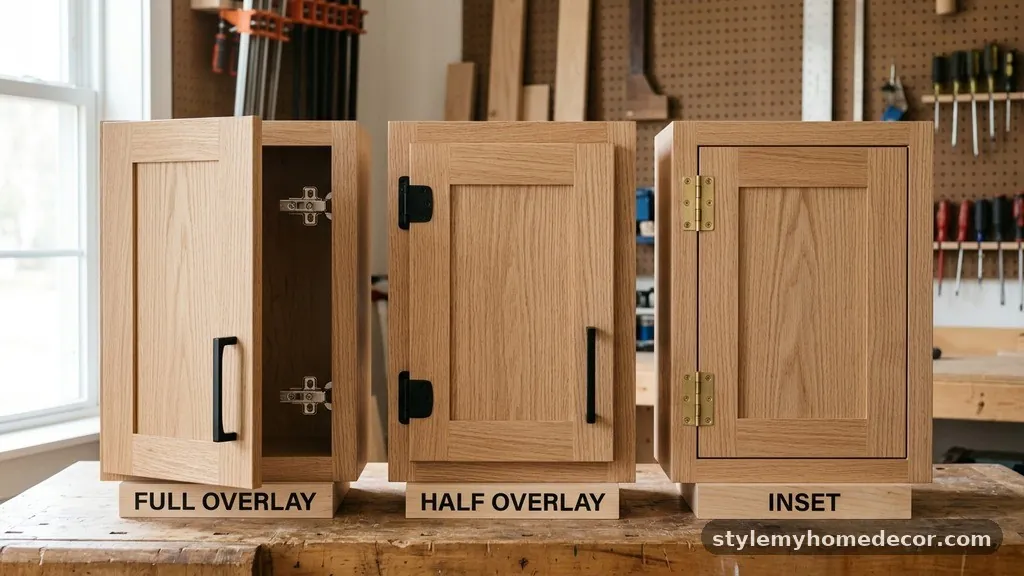
The hardware you need depends entirely on the overlay style you select. Inset doors typically require specialized hinges that are mounted to the inside of the cabinet frame.
These are often butt hinges or specialized inset concealed hinges that allow the door to swing out and away from the frame. Because the door sits inside the frame, the hinge must be engineered to clear the wood edge without hitting it.
Full overlay cabinets almost exclusively use European-style concealed hinges. These hinges are mounted to the interior side panel of the cabinet box rather than the face frame.
They are highly adjustable, allowing you to tweak the door position in three dimensions. This adjustability is critical because, with full overlay, the gaps between doors must be perfectly aligned to maintain a uniform appearance.
Half overlay hinges are also typically concealed, but they have a different offset compared to full overlay versions. The hinge arm is cranked to account for the specific amount of frame that remains visible.
If you purchase the wrong hinge type, the door will either sit too far out from the frame or fail to close flush with the adjacent doors. Always verify the overlay dimension of your cabinet system before ordering hardware components.
Installation Precision and Complexity
Installing inset cabinets is widely considered the most difficult task for a carpenter. Since the door sits within a frame, there is very little room for error.
If the cabinet box is slightly out of square, the door will not sit flush, and you will see uneven gaps. Professional installers often spend extra time shimming the cabinets to ensure they are perfectly level and square.
Full overlay installations are significantly more forgiving regarding the cabinet box alignment. Because the doors overlap the frame, you have more leeway to adjust the doors using the screws on the concealed hinges.
This makes them a favorite for DIY enthusiasts who want a modern look without the extreme difficulty of fitting inset doors. However, you must still maintain precise spacing between the doors to prevent them from colliding when opened.
Partial overlay installations are the easiest to manage. The visible frame acts as a visual buffer, meaning that slight variations in door placement are rarely noticed.
If you are working on a tight budget or doing a renovation yourself, this style minimizes the risk of installation-related headaches. It provides a reliable, sturdy result that stands up well to heavy daily use in busy kitchens.
Impact on Storage and Accessibility
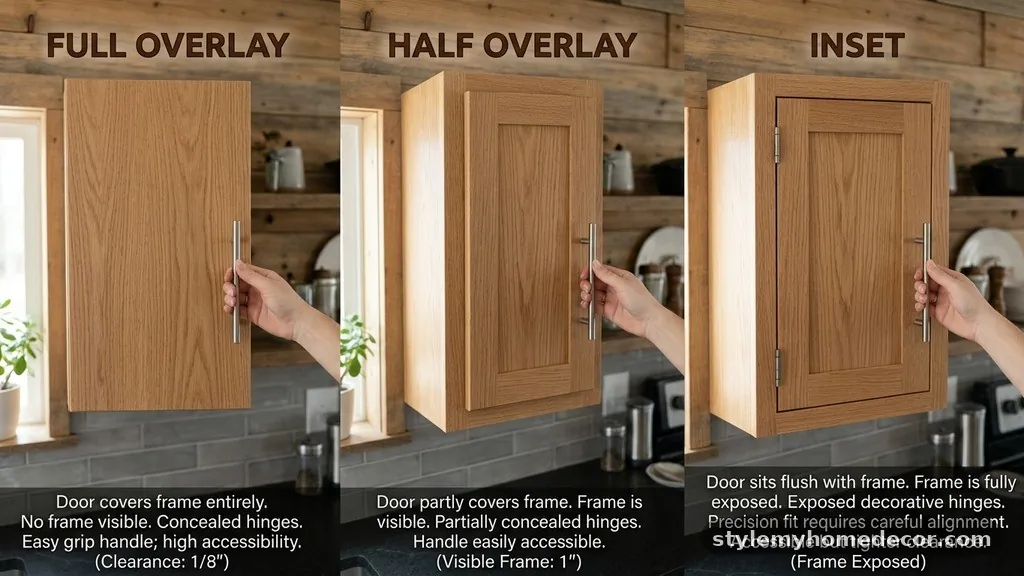
When considering full overlay vs half overlay vs inset cabinets, the impact on internal storage is often overlooked. Inset cabinets inherently lose a small amount of internal volume because the door occupies space within the frame opening.
If you have a narrow cabinet, this can make it difficult to fit larger platters or appliances through the opening. You are essentially working with a smaller clear-opening width than the actual width of the cabinet box.
Full overlay cabinets offer the best access to the cabinet interior. Since the door is mounted to the side of the box, the clear opening is nearly as wide as the cabinet itself.
This is a major advantage in smaller kitchens where every inch of storage space counts. It makes loading and unloading bulky items much easier compared to the more restrictive inset design.
Partial overlay cabinets fall somewhere in the middle of the spectrum. You have a slightly smaller opening than a full overlay cabinet, but you don’t face the same clearance constraints as an inset design.
For most homeowners, the difference in storage efficiency is negligible, but it is worth noting if you have specific storage needs for large kitchen equipment. The following table summarizes the key physical characteristics of these three styles.
| Cabinet Style | Door Placement | Installation Difficulty | Storage Efficiency |
|---|---|---|---|
| Inset | Inside the frame | High | Lower |
| Full Overlay | Covers entire frame | Medium | Highest |
| Half Overlay | Partially covers frame | Low | Medium |
Aesthetic Considerations and Trends
The aesthetic choice between these styles often comes down to the desired “vibe” of the home. Inset cabinetry is synonymous with high-end, custom kitchen design.
It feels timeless and architectural, particularly in shaker or traditional kitchen styles. People who choose this route are usually looking for a bespoke, furniture-like quality that adds lasting value to their home.
Full overlay is the dominant choice for modern and transitional interior design. Its ability to create a seamless, flat surface is perfect for minimalist aesthetics.
When paired with slab doors or simple shaker fronts, it creates a sleek look that feels clean and uncluttered. It is highly versatile and fits well in both small apartments and large, open-concept homes.
Partial overlay has a distinctly traditional or “country” feel. It is common in older homes where the cabinetry was built to last for generations.
While some modern designers view it as dated, it can look excellent when paired with high-quality wood finishes or specific hardware choices. It provides a warm, classic look that feels comfortable and lived-in.
Cost Factors in Cabinetry Selection
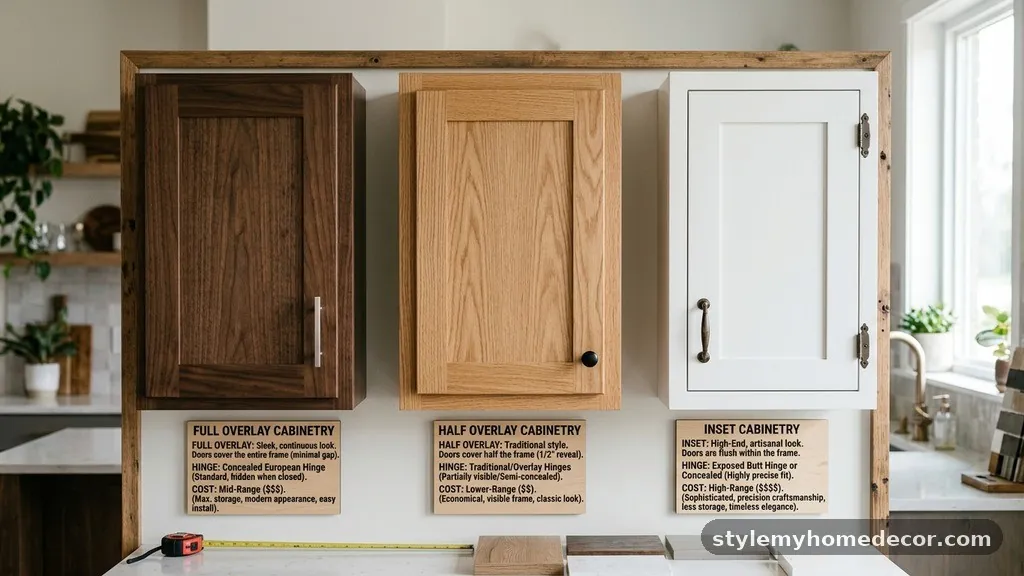
Budget is usually the deciding factor for most homeowners. Inset cabinetry is almost always the most expensive option.
This is due to the labor-intensive nature of building the frames and fitting the doors to such precise tolerances. You are paying for the time and skill required to ensure every door fits perfectly flush.
Full overlay is generally a mid-to-high-range option, depending on the quality of the materials and the hinge system used. Because it is a standard in most semi-custom and custom lines, there are many price points available.
You can achieve the high-end look of full overlay without the extreme labor costs associated with inset designs. This makes it a popular choice for mid-range kitchen remodels.
Partial overlay is the most budget-friendly option. Because the manufacturing tolerances are less strict, these cabinets can be produced more quickly and with less waste.
If you are looking to maximize your budget while still getting a durable, functional product, this is often the best path. You can find more information on standard cabinet specifications through the National Kitchen and Bath Association to help guide your material choices.
Maintenance and Durability
Durability is a concern in any busy kitchen. Inset doors are susceptible to seasonal wood movement.
If you live in a climate with high humidity fluctuations, you might find that your inset doors rub against the frame during the summer months. This might require periodic adjustments to the hinges or even professional intervention to re-plane the door edges.
Full overlay doors are generally more stable because they are not constrained by a surrounding frame. They are less likely to stick during humid weather, provided the hinges are installed correctly.
However, you must be careful to avoid bumping the doors against each other if they are adjacent. If the hinges go out of alignment, the doors can scratch or chip each other, which is a common maintenance issue in full overlay kitchens.
Partial overlay is quite durable due to its simple construction. There is enough of a gap between the doors that they rarely rub against one another.
The hinges are robust and rarely need adjustment once they are set properly. If you want a kitchen that requires minimal maintenance over the long term, this is a very reliable choice.
Hardware and Accessory Integration
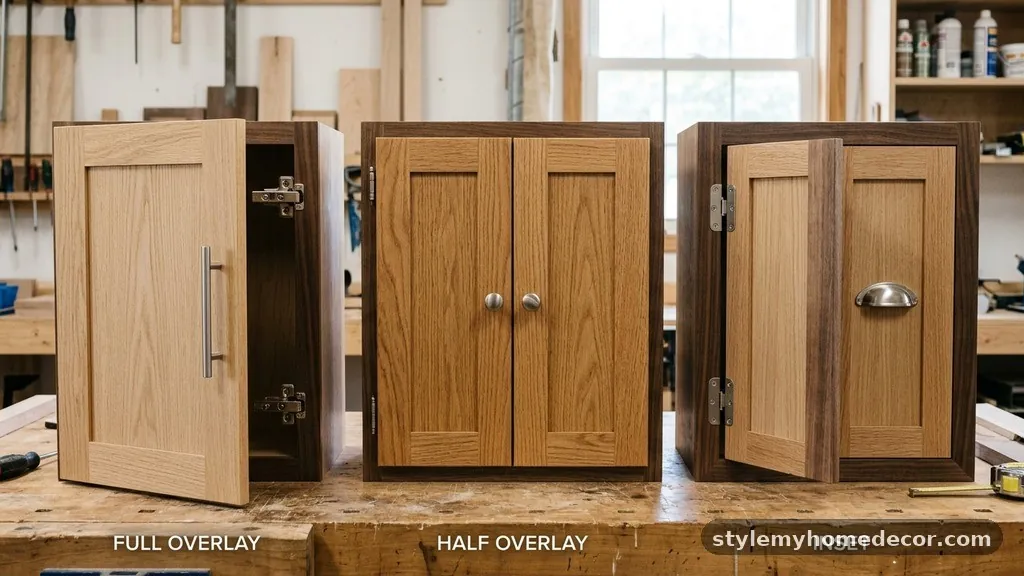
The type of hardware you choose can significantly impact the functionality of your cabinets. With inset doors, you are limited in your choice of hinges, but you have more options for decorative hardware.
Many homeowners choose to highlight the inset look by using exposed hinges, which can serve as a design feature. It adds a touch of vintage charm that works well in farmhouse or period-appropriate homes.
Full overlay kitchens rely almost entirely on concealed, soft-close hinges. While this hides the hardware, it allows you to focus on the cabinet pulls or knobs as the main visual element.
Because the doors cover the frame, you have a larger surface area to mount your chosen hardware. This gives you more flexibility to experiment with larger or more statement-making handles.
Partial overlay allows for both concealed and semi-exposed hinges. If you want a traditional look, you might choose decorative hinges that are visible on the cabinet face.
This can be a great way to tie the kitchen together with other metal finishes in the room, such as faucet hardware or light fixtures. The hardware choices for these cabinets are diverse and offer plenty of room for personal expression.
Common Problems and Solutions
One of the most frequent complaints with full overlay cabinets is the “door-to-door” rub. This happens when the doors are not perfectly aligned, causing them to collide as they open or close.
The solution is usually a simple adjustment on the concealed hinge, which allows you to move the door up, down, left, or right. If the doors are still rubbing, you may need to adjust the depth screw to pull the door slightly away from the frame.
Inset cabinet owners often struggle with sticking doors. This is a common issue when the wood expands in the summer.
A temporary solution is to use a dehumidifier in the kitchen to stabilize the environment. If the problem persists, a professional carpenter may need to trim the edge of the door to provide more clearance.
For partial overlay cabinets, the most common issue is hardware fatigue. Because these cabinets are often older, the original hinges may wear out or become loose.
Fortunately, replacing these hinges is usually straightforward. You can often find modern, soft-close replacements that fit the existing holes, instantly upgrading the functionality of your older cabinets.
Frequently Asked Questions
When should I choose inset over full overlay?
You should choose inset cabinets if you are aiming for a classic, high-end, or furniture-style aesthetic and have the budget to account for the higher labor costs. It is the best choice for traditional or period-style homes where the architectural detail of the frame is a key part of the design.
Are full overlay cabinets considered modern?
Yes, full overlay cabinets are a staple of modern and transitional kitchen design. Their ability to minimize visible frame gaps creates a clean, uniform look that is essential for contemporary styles. They are often used in slab-door designs to emphasize simplicity.
Do full overlay cabinets require special hinges?
Full overlay cabinets require specific concealed hinges that are designed to mount to the side of the cabinet box. These hinges are engineered to allow the door to sit perfectly flush over the face frame while maintaining the necessary clearance for a soft-close function.
What are the main disadvantages of inset cabinets?
The main disadvantages of inset cabinets are the higher cost due to installation complexity and the potential for the doors to stick during periods of high humidity. They also offer slightly less internal storage space compared to full overlay designs.
Is partial overlay outdated?
While some designers lean toward full overlay for its modern appeal, partial overlay is not inherently outdated. It remains a practical, cost-effective, and durable choice that works well in traditional, rustic, or budget-focused kitchen remodels.
Conclusion
Selecting between full overlay vs half overlay vs inset cabinets is a balance of your personal style, your budget, and the level of maintenance you are willing to accept. Inset cabinetry provides a timeless, high-end look but demands precision and comes with a higher price tag. Full overlay offers a modern, seamless appearance with the added benefit of easier access to your stored goods.
Meanwhile, partial overlay remains a reliable, cost-effective solution for those who prefer a classic, functional kitchen. By weighing these hardware differences and structural requirements, you can ensure your choice aligns with your long-term goals for your home. We encourage you to visit a local showroom to see these styles in person, as feeling the movement of the hinges and seeing the reveals firsthand will provide the final clarity you need for your project.